All schools must provide a curriculum that is broadly based, balanced and meets the needs of all pupils. Under section 78 of the Education Act 2002 and the Academies Act 2010, a PSHE curriculum:
An amendment to the Children and Social Work Act 2017 made Relationships and Health Education at primary; and Relationships, Sex, and Health Education at secondary, statutory subjects. The DfE guidance on Relationships, Health and Sex Education for governing bodies can be seen here. This became active from September 2020.
The current statutory PSHE documentation is here. In July 2024 the consultation closed for the new guidance – a summary of this draft statutory guidance can be found here. This policy is also underpinned by a range of other legislation and guidance – please see appendix 1 for a full list and links to the additional documentation.
The aims of the policy are:
Pupils take part in a variety of learning opportunities across and beyond the curriculum, contributing fully to the life of their school and communities and being active citizens. In doing so they learn to recognise their own worth, work well with others, and form positive relationships, and become increasingly responsible for their own learning. They reflect on their experiences and understand how they are developing personally and socially, tackling many of the spiritual, moral, social and cultural issues that are part of growing up. They become aware of their own feelings and the feelings of others. They also develop their own opinions and values, and recognise that the opinions and values of others may be different from theirs.
They learn to understand and respect our common humanity; diversity and differences so that they can go on to form the effective, fulfilling relationships that are an essential part of life and learning.
The Cabot Learning Federation is committed to, recognises, and celebrates diversity and intersectionality, including that which exists within our pupil and staff populations and the communities we serve. We are committed to advancing equal opportunities for all and eliminating discrimination on any basis, including age, disability, gender reassignment, marriage and civil partnership, pregnancy and maternity, religion or belief, sex and sexual orientation (defined as Protected Characteristics) so that equality, diversity and inclusion (EDI) underpin all we do. In relation to the enactment of this policy, this commitment and celebration of diversity will include:
In our schools we choose to deliver Personal, Social, Health Education using Jigsaw and other resources and source materials. Academies will need to check the overview content highlighted below, and adapt as appropriate for local context. This is a mindful approach to PSHE. This is supplemented with additional resources where appropriate. Many of the Primary and some Secondaries in the CLF use Jigsaw, or the PSHE Association framework.
Jigsaw is used as a resource in many of our Primaries.
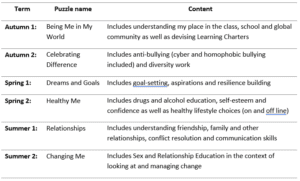
Jigsaw covers all areas of PSHE for the primary phase, as the table below shows: (individual academies to order)
Definition:
From September 2020, Relationships Education is compulsory for all primary schools as set out in the DfE Guidance (2019). For all maintained schools there is also a statutory duty to provide Health Education. This includes primary aged children learning about the ‘changing adolescent body’, included in the expected outcomes for primary Health Education. (Relationships Education, Relationships and Sex Education, and Health Education, DfE, 2019).
Effective Relationships, Health and Sex Education can make a significant contribution to the development of the personal skills needed by pupils if they are to establish and maintain relationships. It also enables children and young people to make responsible and informed decisions about their health and well-being. This is why the DfE recommend:
“… that all primary schools should have a sex education programme tailored to the age and the physical and emotional maturity of the pupils. It should ensure that both boys and girls are prepared for the changes that adolescence brings and – drawing on knowledge of the human life cycle set out in the national curriculum for science – how a baby is conceived and born.” (Relationships Education, Relationships and Sex Education, and Health Education, DfE, 2019, para 67).
Compulsory aspects of Relationships, Sex and Health Education.
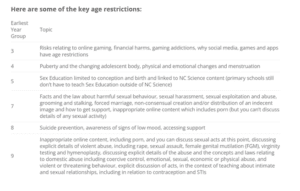
End of primary expectations and curriculum content is given in the Relationships Education, Relationships and Sex Education, and Health Education DfE guidance (2019). These are available in Appendix 1. The new DRAFT guidance (2024) sets out a series of age restrictions for content taught – and this is one of the aspects of the draft guidance that is currently being contested by various campaign groups.
The sex education contained in National Curriculum science (Key Stages 1–4) is compulsory.
RHSE plays a very important part in fulfilling the statutory duties all schools have to meet. RHSE helps children understand the difference between safe and abusive relationships and equips them with the skills to get help if they need it. It also teaches them about the importance of a healthy lifestyle and positive mental health, about online and off line safety. Schools have responsibilities for safeguarding and a legal duty to promote pupil well-being (Education and Inspections Act 2006 Section 38).
RHSE has clear links with other school policies aimed at promoting pupils’ spiritual, moral, social and cultural development, including:
(Academies to adjust the individual names of the policies listed here)
The role of the Principal, Academy Council and CLF Board
It is the responsibility of the CLF board to ensure that as well as fulfilling their legal obligations, the boards should also make sure that:
The Principal liaises with external agencies regarding the school RHSE programme and ensures that all adults who work with children on these issues are aware of the school policy, and that they work within this framework. The Principal monitors this policy on a regular basis and reports to the Academy Council, when requested, on the effectiveness of the policy. Parents have been consulted on the RHSE policy into practice and provision and have the opportunity to express their views.
Equalities
The Equality Act 2010 determines the way the curriculum is delivered, as schools and other education providers must ensure that issues are taught in a way that does not subject pupils to discrimination, and in a way which supports a clear understanding of the protected characteristics under the Equalities Act 2010. Schools have a duty under the Equality Act to ensure that teaching is accessible to all children and young people, including, when thinking specifically about Relationships, those who are lesbian, gay, bisexual and transgender (LGBT). Inclusive RHSE will foster good relations between pupils, tackle all types of prejudice and promote understanding and respect. The Department for Education has produced advice on The Equality Act 2010 and schools (DfE, 2014b).
Schools have a legal duty to promote equality (Equality Act, 2010) and to combat bullying (Education Act, 2006) (which includes homophobic, sexist, sexual and transphobic bullying) and Section 4.2 of the national curriculum (2014) states “Teachers should take account of their duties under equal opportunities legislation that covers race, disability, sex, religion or belief, sexual orientation, pregnancy and maternity, and gender reassignment.”
“Schools should be alive to issues such as everyday sexism, misogyny, homophobia and gender stereotypes and take positive action to build a culture where these are not tolerated, and any occurrences are identified and tackled. Staff have an important role to play in modelling positive behaviours. School pastoral and behaviour policies should support all pupils.” (DfE, 2019)
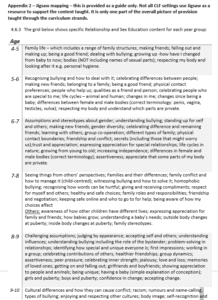
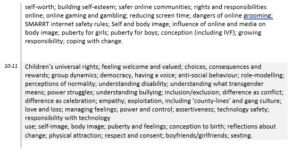
Jigsaw RSE sample content – the detail of the content mapped out using Jigsaw is included within the appendix
Withdrawal from Relationship and Sex Education lessons
Parents/carers have the right to withdraw their children from Sex Education provided at school except for those parts included in statutory National Curriculum Science and that included within Statutory Relationships and Health Education. Those parents/carers wishing to exercise this right are invited in to see the Principal in school who will explore any concerns and discuss any impact that withdrawal may have on the child. Withdrawal will be monitored across the trust to enable us to work positively and proactively with families and community groups. Once a child has been withdrawn they cannot take part in the specific sex education lessons (this does not include the science lessons) until the request for withdrawal has been removed. Materials are available to parents/carers who wish to supplement the school sex education programme or who wish to deliver sex education to their children at home. Parents and carers cannot withdraw from any aspect of Relationships Education and Health Education lessons covering the changing adolescent body (puberty).
Working with parents and carers
The government guidance on Relationships, Sex Education and Health Education (DfE, 2019) emphasises the importance of schools working in partnership with parents and carers. The draft 2024 guidance reinforces the requirement to consult with parents/carers and to ensure curriculum content is available for parents/carers to view. We would extend this to recognise the curriculum content materials should be available to a wider group – in line with the recommendations from the PSHE Association. Parents/carers should be aware that schools are legally required to provide a broad and balanced curriculum. Sex, health and relationships topics can arise incidentally in other subjects, such as Science, Geography, History, RE, and it is not possible to withdraw pupils from these relatively limited and often unplanned discussions. Parents should be given every opportunity to understand the purpose and content of Relationships Education and RSHE. Good communication and opportunities for parents to understand and ask questions about the school’s approach can help increase confidence in the curriculum.
Effective Health Education can make a significant contribution to the development of the personal skills needed by pupils as they grow up. It also enables young people to make responsible and informed decisions about their own and others’ health and well-being. Safer online awareness through the curriculum – in the CLF RSHE curriculum content, children are given the opportunity to learn about how to keep themselves and others safe online. Proactive and preventative curriculum content which addresses contextual safeguarding risks is planned in through clear and regular communications within Safeguarding and Leadership teams. Within the CLF Safeguarding policy 2022, there is an expectation that the Designated Safeguarding Lead works alongside the SLT and teaching teams to develop an effective and proactive culture of safeguarding across the Academy, including links to Online Safety, Relationship, health and sex education and PSHE.
Moral and Values Framework
The Health Education programme at our school reflects the school ethos and demonstrates and encourages the following values. For example:
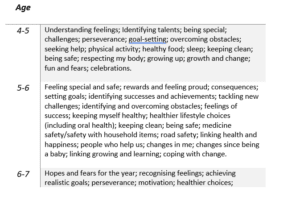
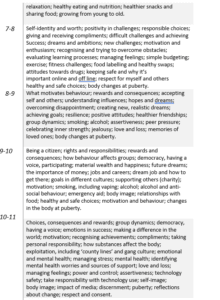
Jigsaw’s Health Education Content
The grid below shows specific Health Education content for each year group:
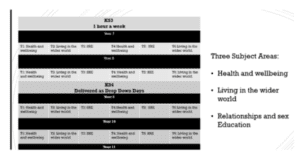
For those Academies not using Jigsaw, the content needs to be in-line with legislation and take into account guidance, including the PSHE Association framework.
An example may look like the following overview
Differentiation/SEND
As will all subjects, teachers will need to tailor each lesson to meet the needs of the children in their class.
They will consider:
Safeguarding
The school has a separate Safeguarding and Child Protection Policy. RHSE, Online Safety, PSHE – all play an important part in helping children to understand the difference between safe and unsafe relationships and equips them with the skills to get help if they need it. Effective RSE may bring about disclosures of child protection issues and staff are fully aware of the procedures for reporting their concerns. Safeguarding through the curriculum is an essential aspect of the enactment of this policy. Children are taught about how to stay safe online, through both the RSHE and the computing curriculum, in addition to the broader PSHE curriculum.
Teachers need to be aware that sometimes disclosures may be made during RHSE lessons; in which case, safeguarding procedures must be followed immediately. Sometimes it is clear that certain children may need time to talk one-to-one after the lesson closes. It is important to allow the time and appropriate staffing for this to happen. If disclosures occur, the school’s disclosure and/or confidentiality policy is followed.
Monitoring and evaluation
The RHSE leader will monitor delivery of the programme through observation and discussion with teaching staff to ensure consistent and coherent curriculum provision.
Evaluation of the programme’s effectiveness will be conducted on the basis of:
External contributors
External contributors from the community, e.g. health promotion specialists, school nurses, social workers, and community police and fire officers, make a valuable contribution to the RHSE and PSHE curriculum. Their input is carefully planned and monitored so as to fit into and complement the learning.
Teachers/leaders are always be present during these sessions and remain responsible for the delivery of the RHSE programme.
The July 2024 Draft Statutory Guidance contains the following:
Whilst it is recognised that new DRAFT statutory guidance has been issued, schools are currently expected to consider the most appropriate curriculum content based on their context and their students so this is included here for reference only at this stage. The following is a statement from the PSHE Association regarding the draft guidance and relating specifically to the age restriction aspects:
A key part of a PSHE teacher’s job is therefore to ensure teaching is not only age but also stage appropriate, using assessment techniques, knowledge of the pupils in their classes, local and national health data and professional judgement. Proposed age restrictions fail to recognise this crucial part of PSHE teaching or its importance in ensuring that education can be genuinely preventative.
By the end of primary school: Families and people who care for me
Pupils should know
that others’ families, either in school or in the wider world, sometimes look different from their family, but that they should respect those differences and know that other children’s families are also characterised by love and care.
Caring friendships
Pupils should know
Respectful relationships
Pupils should know
Online relationships
Pupils should know
Being safe
Pupils should know
By the end of secondary school:
Schools should continue to develop knowledge on topics specified for primary as required and in addition cover the following content by the end of secondary:
Families
Respectful relationships, including friendships:
Respectful relationships, including friendships Pupils should know
Online and media
Pupils should know:
Being safe
Pupils should know
Intimate and sexual relationships, including sexual health
Pupils should know
Since September 2020 parents can only opt to withdraw their child from sex education elements of RSHE (not relationship elements), up to and until three terms before the child turns 16. After that point, if the child wishes to receive sex education rather than be withdrawn, the school must make arrangements to provide the child with sex education during one of those terms.
Legislation:
Guidance – a number of these documents will require review and update following the mid-year review in line with DfE publications